
Çarşamba, Eylül 18, 2013
Çarşamba, Ağustos 14, 2013
However Many Takes It Takes
Well candles burn you warm and safe
You lock your door and control your space
And curtains drawn, you think that you're impenetrable
But demons they don't live outside
They burrow deep where they can hide
Inside a safe, you will still feel vulnerable
Perşembe, Ocak 10, 2013
Salı, Aralık 18, 2012
Sarı
...
Aynı kuru kahveciden gün aşırı iş olsun diye
Yüzer gram kahve alıp evde iş olsun diye öğütüyorlar
Ve bir gün bile sormuyorlar öğütülmüşünü
Kimse sormuyor iş olsun diye yapılan iş, iş midir diye
...
Aynı kuru kahveciden gün aşırı iş olsun diye
Yüzer gram kahve alıp evde iş olsun diye öğütüyorlar
Ve bir gün bile sormuyorlar öğütülmüşünü
Kimse sormuyor iş olsun diye yapılan iş, iş midir diye
...
Çarşamba, Ocak 26, 2011
Olek and the Charging Bull on Wall Street
I had seen photos of the crocheted bull before, but I just found the video of the installation process. Olek is one of the speakers of "The Artist Life in New York" panel which will take place at Pratt on February 1st. The other artists who will be speaking at the panel are: Aaron Wexler, Jennifer Sullivan, Naomi Reis, Ella Kruglyanskaya, and Matt Jensen.
NYFA Panel Discussion at Pratt: "The Artist Life in New York"
Date and Time: February 1, 2011 | 6:00 - 8:00 PM
Location: Alumni Reading Room (3rd floor of the library)
Pazartesi, Ocak 10, 2011
Thoughtless Acts
A few years ago I saw a book called "Thoughtless Acts" by Jane Fulton Suri and IDEO. The book, which also has a website, was full of examples of intuitive ways people adapted, exploited and reacted to their surroundings. The point was to recognize those things we do without thinking, and use them as insights for creating thoughtful designs.
I walked around the campus and my neighborhood to see whether I could find some examples of thoughtless acts myself. And here is what I found with some notes:
 Conforming & Exploiting: The information board that holds the campus map for display is now mostly used for displaying information on student activities and meetings. The map is now only partially visible. The function is not altered, but exploited. A board for permanently displayed information has become a tool for temporary messages. Even the legs holding the board is used for sticking messages.
 Responding: The match box is intuitively inserted in the space between the logs of the bench. It is perfect for the match box. The compatibility must have tempted the smoker to leave his waste right there, where he sat down to smoke his cigarette.
 Exploiting: The tree acts as a support; a perfect parking spot for the bicycle. Environmental features are exploited due to their affordances.
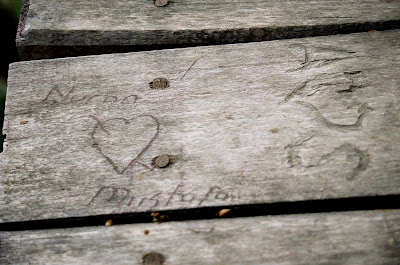 Co-opting & Exploiting: Names of lovers are carved on the surface of the wooden picnic table. Users have taken advantage of the physical qualities of wood to leave a mark after them.
 Adapting & Co-opting: The beaded decoration is hung on the handle of the kitchen window. Thus, the handle provides an affordance other than its fundamental function of opening/closing the window. The person uses the handle intuitively for hanging stuff, as it is the closest thing to a hanger in the environment.
 Conforming & Exploiting: There is a high school across the border defining wall of this housing complex. The students have taken advantage of the large surface of the wall and turned it into a message board for themselves. Although the residents are not pleased with this habit, once several messages got written on the wall, other students started to use it for the same purpose too.
 Adapting: I found this book in my library with a bus ticket from 2004 in it. I was reading the book during a long-distance bus trip, and made use of the ticket as a bookmark.
 Adapting & Co-opting: The bags are hanging from the door knob instead of being stored in a cabinet or hung from a hanger. The door knob can no longer perform its primary function; users must not feel the need to shut their door often. The arrangement makes it easy for the users to grab whichever bag they want before leaving the room.
I walked around the campus and my neighborhood to see whether I could find some examples of thoughtless acts myself. And here is what I found with some notes:
 Conforming & Exploiting: The information board that holds the campus map for display is now mostly used for displaying information on student activities and meetings. The map is now only partially visible. The function is not altered, but exploited. A board for permanently displayed information has become a tool for temporary messages. Even the legs holding the board is used for sticking messages.
 Responding: The match box is intuitively inserted in the space between the logs of the bench. It is perfect for the match box. The compatibility must have tempted the smoker to leave his waste right there, where he sat down to smoke his cigarette.
  Exploiting: The tree acts as a support; a perfect parking spot for the bicycle. Environmental features are exploited due to their affordances.
  Co-opting & Exploiting: Names of lovers are carved on the surface of the wooden picnic table. Users have taken advantage of the physical qualities of wood to leave a mark after them.
 Adapting & Co-opting: The beaded decoration is hung on the handle of the kitchen window. Thus, the handle provides an affordance other than its fundamental function of opening/closing the window. The person uses the handle intuitively for hanging stuff, as it is the closest thing to a hanger in the environment.
 Conforming & Exploiting: There is a high school across the border defining wall of this housing complex. The students have taken advantage of the large surface of the wall and turned it into a message board for themselves. Although the residents are not pleased with this habit, once several messages got written on the wall, other students started to use it for the same purpose too.
 Adapting: I found this book in my library with a bus ticket from 2004 in it. I was reading the book during a long-distance bus trip, and made use of the ticket as a bookmark.
 Adapting & Co-opting: The bags are hanging from the door knob instead of being stored in a cabinet or hung from a hanger. The door knob can no longer perform its primary function; users must not feel the need to shut their door often. The arrangement makes it easy for the users to grab whichever bag they want before leaving the room.
Green = Guilt?

The main marketing strategy for selling green products has been to exploit the eco qualities of the products, rather than promoting their functionality or aesthetics. Some designers tend to oversee the functional and aesthetic aspects for the virtue of designing a green product. But doesn't that produce more trash?
It is true that guilt or being worried about the future well-being of his/her children may cause the consumer to behave in an ecologically responsible manner. (Moisander, 1997) However Debra Lilley, a research associate at Loughborough Design School, taking reference from the 2003 UNEP reports, states that guilt is not a sufficient motivator, and subsequently policy makers are beginning to realize the limitations inherent in this approach.
What green products offer to users should not only be a feeling of conscience or guilt. Regarding the mechanism of evoking emotions through products, Pieter Desmet proposes that if a product looks or performs in a way that corresponds with a concern of the user, a pleasant emotional response will be the result. We have to bear in mind that a big part of society does not carry a strong environmental concern to be emotionally engaged to use green products just because of their greenness. These products need to engage and connect with users through other qualities that converge with the primary concerns of users, in order to evoke pleasant emotions.
As a consumer, I want choices so I can find the product that best speaks to my taste. I should not be confined to buy that one product in a brown paper pulp packaging as my only choice, if I wish to make green choices. Don't get me wrong, I don't have a problem with brown colored things or paper pulp. In fact, I like them both. But I want to make the point that there is a good selection of environmentally friendly materials available to designers to create their products -and not all of them are brown! A successful shift to green products will happen when the greenness -or the brownness in this case :)- of those products will not be the only quality that shouts at the conscious user.
As designers, we can challenge ourselves to create a variety of products catering to a wide range of tastes that are green; yet are beautiful and functional regardless of anything. I don't find it very ethical to put the consumer on a spot, where they need to make a selection between what they want to buy, and what they should buy. Designers can take the responsibility to refuse to create anything un-green, and make green the norm.
---
Moisander, J. (1997) Complexity and Multidimensionality of Ecologically Responsible Consumer Behaviour, part 1 of Linden, A L, Moisander, J. Thelander, Å. and Uusitalo, L. (1997) 'Environmental values attitudes and behaviour: Perspectives on Consumption as a Social Project', In: Consumption, Everyday Life and Sustainability Workshop, Centre for the Study of Environmental Change, Lancaster University.
Cumartesi, Ocak 08, 2011
One Family in Gaza from Jen Marlowe on Vimeo.
Israilli bir arkadasim gondermis bu kisa filmi. Filmin Ingilizce'ye tercumesini yapan ise ayni saldirilarda babasini ve erkek kardesini kaybeden bir baska Filistinli arkadasim. Film 2008'de Gazze'ye yapilan saldiri sirasinda ogullari katledilen bir aile hakkinda. Saldiridan birkac ay sonra cekildigi icin ailenin kayiplarinin hemen ertesindeki degil, saldiriyla beraber degisen hayatlarini algilayislariyla ilgili. Ozellikle babanin (Kamal) filmin sonundaki konusmasi yurek parcalayici. Kaybettigi oglu icin yaptigi bahceden basederken diyor ki:
Evim yikildi, hayatim alt ust oldu; ama bu saldiri benim icimdekini yikmadi. Kamal olarak beni oldurmedi. Ailemizi bitirmedi, hayattayiz. Hayat devam etmeli. Cocuklarim icin cicekler dikiyorum. Dogru, sahip olmayi istedigim ya da onceden sahibi oldugum bi hayat degil bu; ama cocuklarim icin elimden geleni yapmaya calisiyorum.
Kimseden yardim olsun diye bana bir ev yapmasini istemem.Ihtiyacimiz olan yardim bu degil. Ihtiyacimiz olan insan olarak degerimizi artiracak, kendini insan olarak hissetmeni, esini bir kadin, evladini da bir cocuk olarak hissetmeni saglayacak bir yardim. Ama nasil? Esas mesele bu. Siddetin olmadigi bir aile nasil kurabilirim? Eger cevabi olan ya da cevabini bilen birini taniyan varsa lutfen bana el uzatin ve cozmeme yardim edin. Bu yeterli.
Bu sacmaliklar neden? Insan oldurmek nasil bu kadar kolay? Ruh hastasi insanlarla bir gezegen paylasiyoruz; ama sanki hastalar akli yerinde olanlardan daha cok. Ve ne yapiyoruz cozume dair? Izliyoruz, uzuluyoruz, cok uzuluyoruz, agliyoruz, sonra arkadasimizla bulusup cay icmeye gidiyoruz, yemek yiyip hayatimiza devam ediyoruz. Bir sonraki filme kadar.
Utaniyorum.
Cuma, Ocak 07, 2011
Perşembe, Ocak 06, 2011
Green Porno
Nazli New York'tayken Rudy'sde bu serinin sescisiyle tanismistik. Ben o zaman ogrendim Isabella Rossellini'nin cok pis pornocu oldugunu. :) Aslinda seri 3.sezonuna girmis, epeydir ortalikta yani. Kisa kisa oldugu icin cerez gibi gidiyor. Is yapmasi gerekip de ertelemek icin her turlu firsati degerlendirmeye hazir olanlara hic uygun degil.
Modern Art

Craig Damrauer'dan "Modern Art". Basarili bir tespit. :)
Buradan satin alinabilir. Kelimeleri matematik esitlikleri haline getirdigi New Math diye bir serisi var. Bu da o seriden bir tane ornek. Kendi sitesinde de bir suru baska esitlikleri mevcut.
Pazartesi, Temmuz 05, 2010
The Dot and the Line: A Romance in Lower Mathematics
Bir noktaya aşık olan düz bir çizginin hikayesi bu. Nokta ise asi görünümlü pervasız karalamaya aşık. Çizgi kendi potansiyelini fark ediyor, gelişiyor, büyüyor, en sonunda da noktayı büyülüyor. Peki doğuştan şanslı nokta, çizgiyi gerçekten hak ediyor mu? :) Chuck Jones ve Maurice Noble tarafından yönetilmiş 1965 yapımı bu çizgi film, o sene kısa animasyon film dalında Oscar almış.
The Dot and the Line: A Romance in Lower Mathematics from http://www.cabezasunderground.co on Vimeo.
Pazartesi, Haziran 21, 2010
Materials for The Arts
Watch the full episode. See more SundayArts.
Türkiye'de de böyle bir kuruluş var mi? Keşke olsa. Bazı şeyleri geri dönüştürmeye gerek yok bile. Yeniden kullanımla da bir çok şeyin ömrü uzayabilir. Teşekkür notları da bence çok iyi düşünülmüş.
Cuma, Haziran 11, 2010
Perşembe, Ağustos 27, 2009
Core 77'de misafir muhabirlik
Impressions from Istanbul Design Weekend 2009 yazim Core77'de yayinlandi. :)

Yazi icin buraya, fotograf galerisi icin şuraya bakabilirsiniz.
Agustos newsletter'inda da Featured bolumunde gorunuyor.

Yazi icin buraya, fotograf galerisi icin şuraya bakabilirsiniz.
Agustos newsletter'inda da Featured bolumunde gorunuyor.
Yapilmayi Bekleyenler
Cooper Hewitt'teki Design for a Living World ve Fashioning Felt sergileri.
MoMA'daki Rona Arad, Rough Cut: Design Takes a Sharp Edge ve The Erotic Object: Surrealist Sculpture from the Collection sergileri.
Queens'te PS1 ve Water Taxi Beach.
Harlem'de Apollo Theatre'da Amator Gecesi.
BAM'de Next Wave Festival (Juliette Binoche ve Akram Khan'li In-I, Lipsynch, Itutu ve Mortal Engine) ve Cate Blanchett'li A Streetcar Named Desire.
Williamsburg'de bar avi. Baslangic yerel tapci Barcade.
Park Slope'u bebek arabalari esliginde kesif.
Governors Island, Staten Island.
Brooklyn Botanic Garden ve yanindan Brooklyn Museum.
...
+
Jude Law'li Hamlet.
Museum of Art and Design'da Object Factory: The Art of Industrial Ceramics sergisi.
MoMA'daki Rona Arad, Rough Cut: Design Takes a Sharp Edge ve The Erotic Object: Surrealist Sculpture from the Collection sergileri.
Queens'te PS1 ve Water Taxi Beach.
Harlem'de Apollo Theatre'da Amator Gecesi.
BAM'de Next Wave Festival (Juliette Binoche ve Akram Khan'li In-I, Lipsynch, Itutu ve Mortal Engine) ve Cate Blanchett'li A Streetcar Named Desire.
Williamsburg'de bar avi. Baslangic yerel tapci Barcade.
Park Slope'u bebek arabalari esliginde kesif.
Governors Island, Staten Island.
Brooklyn Botanic Garden ve yanindan Brooklyn Museum.
...
+
Jude Law'li Hamlet.
Museum of Art and Design'da Object Factory: The Art of Industrial Ceramics sergisi.
Pazartesi, Ağustos 24, 2009

Salı, Temmuz 28, 2009
Impressions from Istanbul Design Weekend 2009
This year, Istanbul Design Weekend took place between 18-21 June 2009 with the theme of “Mediterranean Design between Present and Future”. The four day event aimed to offer two core groups of activities linked by the theme of Mediterranean design. The first group consisted of inedited exhibitions and cultural initiatives related to this theme, whereas the second group consisted of a showroom circuit that allowed ambitious visitors to tour all the participating showrooms, malls and design stores in Istanbul as these stores were invited to take place in a contest for the best installation interpreting the chosen theme through the set up of their spaces and shop windows.

Until this year, Istanbul Design Week used to take place in the old Galata Bridge in Balat. However this year, the city itself -especially the European side- became the exhibition venue for the event. This was especially a really good opportunity to visit the local design firms in their own environment. Seeing what they did with their own space or how they approached the visitors gave a really good impression about who they are. The main problems posed by this act of spreading into the city were the insane amount of time that was required to see all the events, and way-finding, for especially people coming from a different city like us. It is a rare thing to find two parallel streets in some parts of Istanbul due to its hills and really old city planning. Maps were provided for each event zone within the event brochures but these were very abstract, graphic representations rather than functioning as a guide. People at Lunapark told us on the first day of the event that they were seriously considering to place some additional signage on the streets to give better directions to the visitors as they had already received many complaints about this.

Our adventurous tour in Zone 1 which covered the Taksim, Beyoglu and Galata area brought us to the doorsteps of Ilio, whose showroom space was definitely one of the highlights of the event. Finding out later that their exhibition won the first place in the display and installation competition was no surprise at all. Being also the winner of several Red Dot and If awards, Ilio is the home product brand of the Istanbul-based design firm Demirden Design. Their designs in the exhibition were mostly concentrated on tabletop and furniture. You can check out the photos from the exhibition right here.

The student participation in the event was a lot less, compared to previous years. Instead of checking out the same orientalist designs that we have been seeing for years now, it would have been really exciting to see more works by design students whose works afford to be more daring and experimental compared to works coming out of the industry. Marmara University and Mimar Sinan University from Istanbul, and Anadolu University from Eskisehir were the only three universities that displayed their works in the exhibition at Addresistanbul. The architecture faculty of Istanbul Technical University hosted the exhibition of the results of the IMMIB Industrial Design Competition at the beautiful Taskisla building, giving a chance to see some more student work from other universities. The majority of the participants of the “Mediterranean Design between Present and Future” competition were also students. The results got exhibited at the Mozaik showroom. Judging from the participant profile of the competition, the results could have gotten much more interesting and richer in content had the organizers made a more wide-spread announcement within Turkey and all of the other Mediterranean countries. Although this exhibition at Mozaik was announced to be one of the major happenings during IDW 2009, the way the projects were displayed graphically had a lot of room for improvement. Check out the entries and photos from the exhibition here.

Unfortunately, this large room for improvement point was valid for many of the exhibitions part of IDW 2009. Maybe curators and organizers did not have high enough expectations in terms of visitor traffic. It was disappointing to see that even the exhibitions which were going to stay open for four days did not have their signage and information graphics up in the afternoon of the third day. These situations make one wonder whether these exhibitions were organized just for the openings with happy hours for snobbish designers. However, this ’invitation only’ approach doesn’t do much for reaching out to the public and democratizing design.
The ‘Detour Moleskine’ exhibition at Santral Istanbul was definitely one of the highlights of the IDW 2009 event. 50 international artists’ Moleskin notebooks were on display, allowing visitors to go through their sketches, drafts, drawings, and notes in person. Istanbul was the fifth stop of this traveling exhibition after London, New York, Paris and Berlin. In addition to the notebooks of the international artists, an accompanying exhibition called as ‘myDetour’ showcased selected notebooks of students from Istanbul Bilgi University, Domus Academy and the winners of myDetour Berlin. For photos of the winning and participating entries of the myDetour exhibition click here. For photos from both the Detour Moleskin and myDetour exhibitions check out here.
I was also extremely happy to visit Santral Istanbul for the first time thanks to these exhibitions. Before Istanbul Bilgi University opened Santral Istanbul in 2007 as a house for contemporary arts and cultural activities, the building served as the first city scaled power station of the Ottoman Empire. Built in Halic, which used to be the oldest industrial zone of the city, Silahtaraga Power Station was the provider of Istanbul’s electricity between 1911 and 1983. The station is well-conserved and won back to the city as a cultural entity that can revitalize its neighborhood.

Participants of the public street party which Sema Topaloglu organized on the third evening of IDW 2009 also had a good time and were impressed with how she well revitalized a very old building on one of the steepest hills of Istanbul and turned it into an office and residence for herself.
Opening of the Design Library Istanbul was definitely good news for the city too. The library, which is the third branch after Milano and Shanghai, is located in Eski Sapka Fabrikasi in Haskoy. The location which used to serve as an old hat factory on the shore of Golden Horn will now be a really useful address for design lovers in Istanbul.
Check out the album for more photos from Istanbul Design Weekend 2009.

Until this year, Istanbul Design Week used to take place in the old Galata Bridge in Balat. However this year, the city itself -especially the European side- became the exhibition venue for the event. This was especially a really good opportunity to visit the local design firms in their own environment. Seeing what they did with their own space or how they approached the visitors gave a really good impression about who they are. The main problems posed by this act of spreading into the city were the insane amount of time that was required to see all the events, and way-finding, for especially people coming from a different city like us. It is a rare thing to find two parallel streets in some parts of Istanbul due to its hills and really old city planning. Maps were provided for each event zone within the event brochures but these were very abstract, graphic representations rather than functioning as a guide. People at Lunapark told us on the first day of the event that they were seriously considering to place some additional signage on the streets to give better directions to the visitors as they had already received many complaints about this.

Our adventurous tour in Zone 1 which covered the Taksim, Beyoglu and Galata area brought us to the doorsteps of Ilio, whose showroom space was definitely one of the highlights of the event. Finding out later that their exhibition won the first place in the display and installation competition was no surprise at all. Being also the winner of several Red Dot and If awards, Ilio is the home product brand of the Istanbul-based design firm Demirden Design. Their designs in the exhibition were mostly concentrated on tabletop and furniture. You can check out the photos from the exhibition right here.

The student participation in the event was a lot less, compared to previous years. Instead of checking out the same orientalist designs that we have been seeing for years now, it would have been really exciting to see more works by design students whose works afford to be more daring and experimental compared to works coming out of the industry. Marmara University and Mimar Sinan University from Istanbul, and Anadolu University from Eskisehir were the only three universities that displayed their works in the exhibition at Addresistanbul. The architecture faculty of Istanbul Technical University hosted the exhibition of the results of the IMMIB Industrial Design Competition at the beautiful Taskisla building, giving a chance to see some more student work from other universities. The majority of the participants of the “Mediterranean Design between Present and Future” competition were also students. The results got exhibited at the Mozaik showroom. Judging from the participant profile of the competition, the results could have gotten much more interesting and richer in content had the organizers made a more wide-spread announcement within Turkey and all of the other Mediterranean countries. Although this exhibition at Mozaik was announced to be one of the major happenings during IDW 2009, the way the projects were displayed graphically had a lot of room for improvement. Check out the entries and photos from the exhibition here.

Unfortunately, this large room for improvement point was valid for many of the exhibitions part of IDW 2009. Maybe curators and organizers did not have high enough expectations in terms of visitor traffic. It was disappointing to see that even the exhibitions which were going to stay open for four days did not have their signage and information graphics up in the afternoon of the third day. These situations make one wonder whether these exhibitions were organized just for the openings with happy hours for snobbish designers. However, this ’invitation only’ approach doesn’t do much for reaching out to the public and democratizing design.
The ‘Detour Moleskine’ exhibition at Santral Istanbul was definitely one of the highlights of the IDW 2009 event. 50 international artists’ Moleskin notebooks were on display, allowing visitors to go through their sketches, drafts, drawings, and notes in person. Istanbul was the fifth stop of this traveling exhibition after London, New York, Paris and Berlin. In addition to the notebooks of the international artists, an accompanying exhibition called as ‘myDetour’ showcased selected notebooks of students from Istanbul Bilgi University, Domus Academy and the winners of myDetour Berlin. For photos of the winning and participating entries of the myDetour exhibition click here. For photos from both the Detour Moleskin and myDetour exhibitions check out here.
I was also extremely happy to visit Santral Istanbul for the first time thanks to these exhibitions. Before Istanbul Bilgi University opened Santral Istanbul in 2007 as a house for contemporary arts and cultural activities, the building served as the first city scaled power station of the Ottoman Empire. Built in Halic, which used to be the oldest industrial zone of the city, Silahtaraga Power Station was the provider of Istanbul’s electricity between 1911 and 1983. The station is well-conserved and won back to the city as a cultural entity that can revitalize its neighborhood.

Participants of the public street party which Sema Topaloglu organized on the third evening of IDW 2009 also had a good time and were impressed with how she well revitalized a very old building on one of the steepest hills of Istanbul and turned it into an office and residence for herself.
Opening of the Design Library Istanbul was definitely good news for the city too. The library, which is the third branch after Milano and Shanghai, is located in Eski Sapka Fabrikasi in Haskoy. The location which used to serve as an old hat factory on the shore of Golden Horn will now be a really useful address for design lovers in Istanbul.
Check out the album for more photos from Istanbul Design Weekend 2009.
Pazar, Haziran 07, 2009
Kum Kau

En sonuncusu Kum Kau okul yolum ustunde, benim bir ust sokak komsum. Hemen onunde de girenlere cikanlara kapiyi acan mahallemizin homeless'i durur. New York Times'in Fort Greene lokal gazetesinde cikti bu illustrasyon birkac gun once.
Salı, Mayıs 05, 2009

Kaydol:
Kayıtlar (Atom)

